
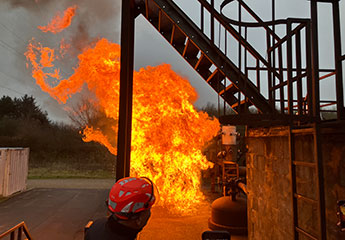

Improving fire safety for methanol-fuelled ships
The shipping industry is undergoing a major transformation as shipowners adopt alternative fuels to reduce greenhouse gas emissions. Methanol has emerged as one of the most promising low-carbon marine fuels. However, the use of methanol also introduces new fire safety challenges that differ from those associated with conventional marine fuels.
Methanol burns with a low-luminosity flame and can form flammable vapour clouds. This makes detection and suppression of methanol fires more complex, particularly in confined spaces such as ship engine rooms.
The MEFISTO project (Methanol Fire Safety Tools – The Devil is in the Detail) aims to generate new knowledge and practical tools that improve the detection and suppression of methanol fires on board ships. Through experimental fire testing, technology evaluation and industry collaboration, the project will support the safe adoption of methanol as a marine fuel.
The project is led by DBI – the Danish Institute of Fire and Security Technology and funded by Lloyd’s Register Foundation.
Background
Methanol is increasingly used as an alternative fuel in shipping because it can reduce emissions and support the maritime industry’s transition toward more sustainable energy systems. As the number of methanol-fuelled vessels grows, it is essential to ensure that fire safety systems are able to manage the specific risks associated with methanol fires.
Traditional fire safety systems on ships were primarily developed for hydrocarbon fuels such as diesel or heavy fuel oil. Methanol behaves differently during combustion and presents challenges related to flame visibility, vapour formation, and suppression performance.
To ensure safe operation of methanol-fuelled vessels, there is therefore a need for new experimental data and validated testing methods that reflect realistic ship engine-room conditions.
The MEFISTO project addresses this need by combining experimental fire testing, modelling and collaboration with maritime stakeholders to evaluate fire detection and suppression technologies specifically designed for methanol fuel systems.
Vision
The vision of MEFISTO is to support the maritime energy transition by ensuring that alternative fuels such as methanol can be adopted without compromising fire safety.
By generating reliable knowledge and practical guidance, the project aims to:
- Improve the detection of methanol vapours and flames in engine rooms
- Evaluate fire suppression technologies suitable for methanol pool fires
- Provide validated data that can support future maritime regulations and safety guidelines
- Strengthen the industry’s ability to safely operate methanol-fuelled vessels
Through this work, the project contributes to the development of safer and more sustainable maritime systems worldwide.
Project activities
The MEFISTO project consists of several research and development activities that together form a structured approach to improving methanol fire safety.
The project begins with a state-of-the-art analysis, where existing regulations, past incidents and previous research related to methanol safety are reviewed.
Next, the project maps and evaluates available fire detection and suppression technologies that could be used to mitigate methanol fire risks in ship engine rooms. This includes both commercially available systems and emerging technologies.
Based on these findings, DBI and the project partners will design a realistic experimental test setup representing a ship engine room. In this controlled environment, methanol pool fires will be generated to evaluate how different fire detection and suppression technologies perform under representative conditions.
Large-scale fire tests will then be carried out together with computational modelling to analyse fire behaviour, system performance and suppression effectiveness.
Finally, the project results will be translated into practical guidance for industry stakeholders, including shipowners, ship designers, regulators and technology suppliers.
Partners and collaboration
The MEFISTO project brings together expertise from across the maritime and fire safety sectors.
The project consortium includes:
- DBI – Danish Institute of Fire and Security Technology (project lead)
- Maersk - Providing end-user insight and operational validation
- RelyOn Nutec - Supporting testing and future training applications
- Odense Maritime Technology (OMT) - Contributing ship design expertise
- Safetytech Accelerator - Supporting technology innovation and collaboration
- Jomo Kenyatta University of Agriculture and Technology (JKUAT) - Contributing academic expertise in fire modelling and supporting global outreach and knowledge exchange.
The project also engages with maritime authorities, classification societies and international research partners to ensure that the results are relevant for global maritime safety developments.
Expected results
The MEFISTO project will generate valuable new knowledge about methanol fire behaviour and fire safety technologies for the maritime sector.
Expected outcomes include:
- Experimental data on fire detection and suppression technologies for methanol pool fires
- Improved understanding of fire behaviour in ship engine rooms
- Guidance for shipowners and designers on selecting appropriate fire safety systems
- Contributions to future regulatory discussions on methanol-fuelled vessels
- Knowledge supporting training and emergency response procedures
By bridging research, testing and industry collaboration, MEFISTO aims to support safe and scalable adoption of methanol as a marine fuel.