Published: 21.01.26
A new study shows how unprotected steel in hybrid steel-timber (HST) floor cross-sections can act as a heat transfer pathway during a fire, increasing charring of the timber in HST connections. However, appropriately designed intumescent coating of the exposed steel surface can prevent this damage under standard fire exposure.
Hybrid steel-timber buildings are increasingly used to reduce embodied carbon while combining the benefits of each material. A common solution is to combine steel beams with cross-laminated timber (CLT) floor slabs, replacing heavier concrete decks. While the structural concept is well established, the fire behaviour at the interface between steel and timber is still less clearly understood.
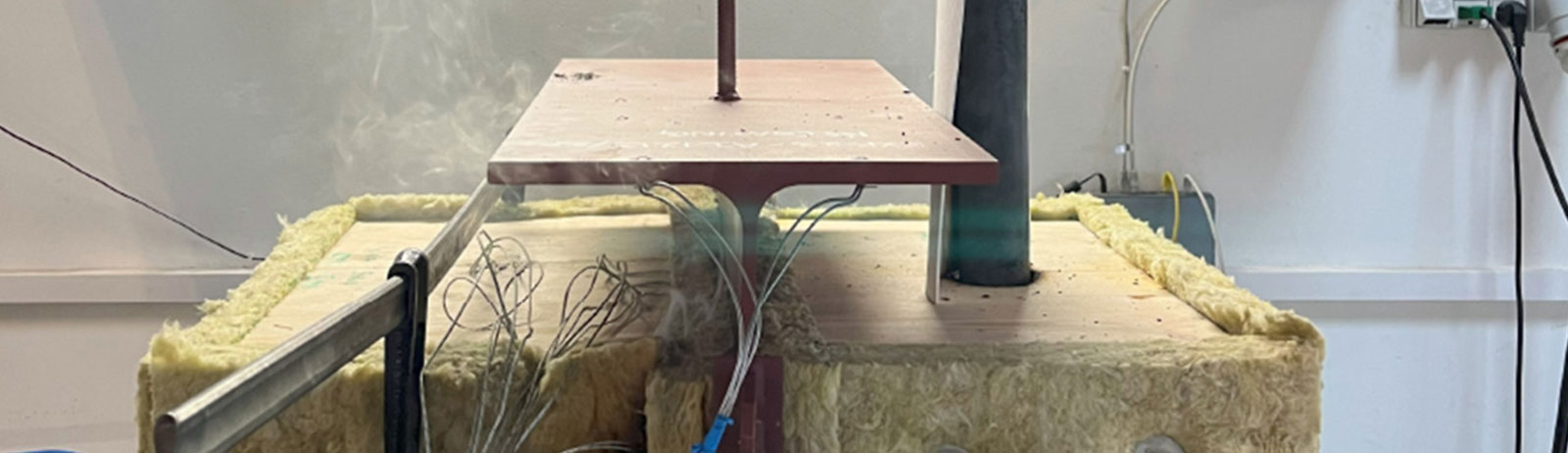
A recent experimental and numerical study examines what happens when a hybrid steel-CLT floor detail is exposed to fire. The study focuses on a configuration where CLT panels rest directly on the bottom flange of a steel H-section – a detail that allows shallow floor build-ups but also creates a critical material interface.
In structural fire design, steel members are typically assessed using critical or limiting temperature criteria, often around 500-550 °C depending on load level and design assumptions. Timber, by contrast, begins to lose strength at much lower temperatures, with significant degradation already occurring around 100 °C and charring generally associated with temperatures around 300 °C.
- A protection strategy that works for steel on its own may be inadequate for the timber that is in contact with it, because the two materials have fundamentally different temperature sensitivities, says Ian Pope, Fire Safety Researcher at DBI and a co-author of the study.
This incompatibility motivated the study, which set out to better understand how heat is transferred through steel-timber connections during fire exposure.
The researchers carried out six small-scale furnace tests under ISO 834-1 standard fire exposure. Three protection strategies were examined: Unprotected steel, steel protected with intumescent coating on the exposed bottom flange only, and steel protected over the entire cross-section.
In all tests, mineral wool insulation was included between the steel web and the CLT, reflecting recommended practice in hybrid steel-timber construction. In such details, insulation is typically used both to limit heat transfer from steel into timber and to reduce the risk of flames and hot gases spreading through the connection.
The experiments show that steel plays a dual role during fire exposure. In the early stages, the bottom flange can partially shield the timber above it from direct heat. As the fire progresses, however, the relatively conductive steel increasingly acts as a heat transfer pathway, conducting heat into the CLT not only from below but also laterally through the web.
- At the corner where the flange meets the web, the timber is heated from more than one direction, which leads to deeper local charring than would be expected from one-dimensional heat exposure alone, says Ana Sauca, Postdoc (PhD) Scientific Researcher at DBI.
Post-test measurements confirmed increased local charring close to the steel web, illustrating how connection geometry influences fire performance.
A central part of the study was the use of intumescent coatings on the steelwork. For fire exposure from below, protecting the exposed steel surface on the bottom flange alone proved sufficient to reduce charring in the adjacent timber, with this ‘partial protection’ performing similarly to full protection.
- In this configuration, it did not make much difference whether the full beam was coated or only the exposed flange, because the exposed surface dominates the heat transfer into the system, says Ian Pope.
Intumescent coatings also require space to expand in order to form an effective insulating char. Where steel is in direct contact with timber or insulation, that expansion can be constrained, which may limit the effectiveness of the coating locally.
Alongside the furnace tests, the researchers implemented a case-specific two-dimensional heat-transfer model within the existing SAFIR software, a widely used finite-element tool for structural fire analysis. The experimental results were used to validate the model against measured temperatures and observed charring for the investigated configuration and standard fire exposure.
At the same time, the study highlights clear limitations that are relevant for practice: The tests were conducted under standard fire exposure only, without any applied weight or structural load, and the connection details did not include fasteners such as screws, which can act as local heat transfer paths in real structures.
Taken together, the findings underline the need to consider steel-timber connections as a coupled system, accounting for the compatibility of the different material behaviours in fire design.
- The fire protection strategy must work for the steel and the timber together, particularly at the connection, rather than relying on standard assumptions developed for single-material systems, says Ian Pope.
The study examines heat transfer and charring in a hybrid floor detail where cross-laminated timber (CLT) panels are supported on the bottom flange of a steel beam, with particular focus on the steel-timber interface during fire exposure.
The experimental programme consisted of six reduced-scale furnace tests carried out under ISO 834-1 standard fire conditions, comparing unprotected steel with steel protected by intumescent coating applied either to the exposed bottom flange (‘partial protection’) or to the full steel section. The experimental work was combined with a case-specific two-dimensional heat-transfer model implemented in SAFIR.
The results show that it is critical to consider the interaction between the two different materials when defining a protection strategy. An unprotected steel beam and connection geometry can create heat transfer paths into the timber, particularly laterally via the web, contributing to increased local heating of the timber. Excessive heating and charring of the timber around the connection could lead to fire spread or even structural failure. However, an appropriately specified intumescent coating of the exposed steel surface was sufficient to minimise timber charring around the interface with the steel, with partial protection performing similarly to full beam protection.
The study, published as ‘Thermal response of hybrid steel-timber floor cross-sections exposed to standard fire: experimental and numerical investigations’ in Fire Safety Journal, was a collaboration between The Danish Institute of Fire and Security Technology (DBI), The University of Edinburgh (UoEd), The University of Sheffield (UoS), and Stora Enso. The authors are Deonisius P. Aprisa (DBI), Ankit Agrawal (DBI), Ana Sauca (DBI), Ian Pope (DBI), Renaud Blondeau-Patissier (Stora Enso), Prof Luke Bisby (UoEd) and Martyn S. McLaggan (UoS).

Ian Pope
Research Consultant, PhD